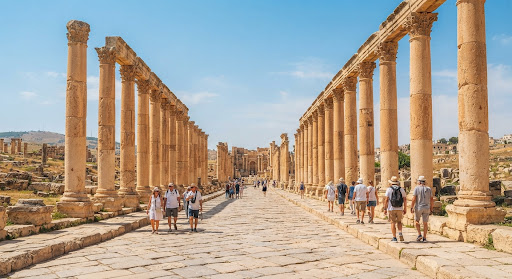
Hadrian's Arch, the Oval Plaza and colonnaded streets — a day trip two thousand years back in time, one hour north of Amman.
Rome is crowded. Pompeii is crowded. Jerash, an hour north of Amman, is a complete Roman provincial city — arches, temples, theatres, fountains and a colonnaded main street still bearing the ruts of chariot wheels — and on a weekday morning you can have long stretches of it nearly to yourself.
People have lived on this plain for more than 6,500 years. The city was taken by Pompey in 63 BC and grew rich as one of the ten cities of the Decapolis, trading along the caravan routes. An earthquake in the eighth century buried much of it in sand, which is precisely why so much of it survived.
Hadrian's Arch
You enter beneath a triumphal arch raised for the emperor Hadrian's visit in the second century — a piece of civic flattery so ambitious that the city never quite grew out to meet it. Beyond it lies the hippodrome, where chariot races once ran before crowds of thousands.
The Oval Plaza
Then the view that makes the trip. The colonnaded forum is not the usual Roman rectangle but a broad, elegant oval, ringed by Ionic columns and paved with limestone that has been polished by two millennia of feet. Standing at its centre with the Temple of Zeus rising behind you is the single best moment in Jerash.
The Cardo Maximus
From the plaza the main street runs 800 metres north, still lined with columns. Look down as you walk: the paving stones carry the grooves worn by cartwheels, and manhole covers still open onto the Roman drainage system running beneath. Halfway along, the Nymphaeum — the city's ornamental fountain — retains its carved basin and traces of the marble that once sheathed it.
The Temple of Artemis
Artemis was the city's patron goddess and her temple was built to impress: colossal Corinthian columns on a high terrace. Guides here like to wedge a spoon or a key into a joint at the base of a column and let you watch it move — the drums were engineered to sway fractionally in wind and tremor rather than snap. Two thousand years on, they still do.
The South Theatre
The 3,000-seat theatre has acoustics so precise that a voice from the centre of the stage carries clearly to the top row. Musicians in Jordanian army uniform often play bagpipes and drums here — an inheritance from the British-era Arab Legion, and a genuinely surreal, wonderful thing to stumble into among Roman stones.
Good to know
Go in the morning. There is almost no shade in Jerash, the stone reflects heat, and the light on the columns is far better before noon.
Practical notes
- chevron_rightAllow two to three hours to walk the site properly; it is larger than it first appears.
- chevron_rightRoughly 45–60 minutes from Amman by road, which makes it an easy half-day.
- chevron_rightPair it with Ajlun Castle — the Ayyubid fortress in the hills above, built in 1184 AD, with views across the Jordan Valley.
- chevron_rightWear shoes with grip. The polished paving is genuinely slippery.
- chevron_rightA guide is worth it here. Without one, it is beautiful rubble; with one, it is a city.
Travel this with us
Jerash opens our Adventure Enthused journey, paired with the castle and forests of Ajlun before the road turns south toward Petra.