The Monastery at dawn, the High Place of Sacrifice, and the quiet back routes of the Rose Red City — how to experience Petra without the crowds.
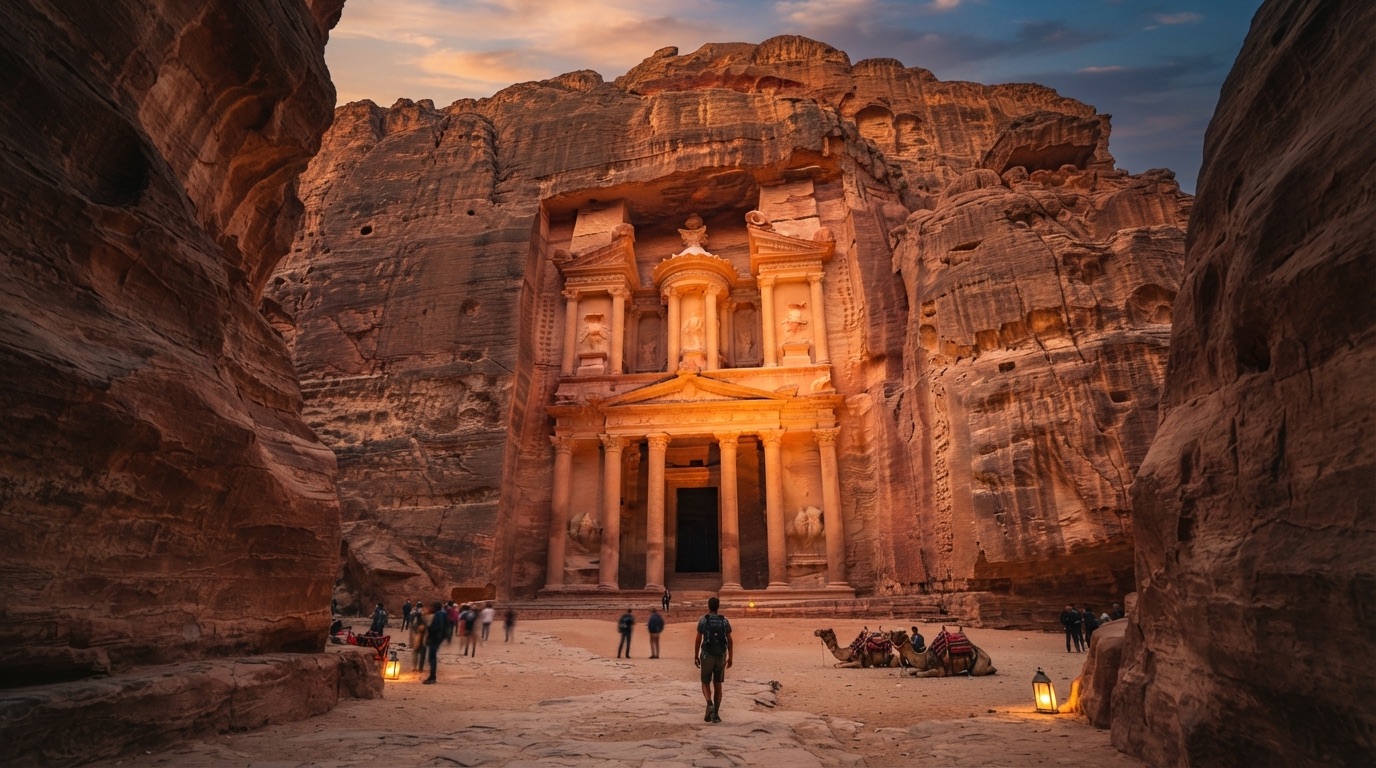
Most people meet Petra the same way. They walk the Siq, the walls part, the Treasury appears — and about ninety minutes later they are back on the bus. It is a spectacular ninety minutes. It is also a fraction of the city.
Petra is not a monument; it is a metropolis. The Nabataeans carved it out of the sandstone more than two thousand years ago, and the archaeological park sprawls across hundreds of square kilometres of tombs, temples, staircases and processional routes. Give it two days and it becomes one of the great walks of the world. Here is where to spend the extra hours.
The Monastery (Ad-Deir)
If you do only one climb, make it this one. Around 800 rock-cut steps rise from the basin floor to a façade that dwarfs the Treasury — roughly fifty metres across, standing alone on a high plateau. The ascent takes most people forty-five minutes to an hour, with Bedouin stalls selling tea and pomegranate juice in the shade along the way.
Go late in the afternoon. The Monastery faces roughly north-west, so the low sun turns the whole face gold while the morning crowds are long gone. Carry water; there is little shade on the stairs themselves.
The High Place of Sacrifice
A steep staircase near the Roman theatre climbs to an ancient altar platform with the finest panorama in Petra — the entire valley, the Royal Tombs opposite, and the mountains rolling away toward Wadi Araba.
The trick is not to come back the way you came. Descend the far side through Wadi Farasa, past the Lion Monument, the Garden Tomb and the Roman Soldier Tomb, and you emerge near the Qasr al-Bint at the end of the main street. It turns an out-and-back into a loop, and you will have long stretches of it entirely to yourself.
The view down onto the Treasury
Those photographs taken from above the Treasury, looking down into the plaza, are from the Al-Khubtha trail — a staircase that leaves from near the Royal Tombs and ends at a viewpoint on the clifftop. It is a solid climb and worth every step, particularly mid-morning when sunlight fills the façade below.
The Royal Tombs, early
The Urn, Silk, Corinthian and Palace tombs line the eastern cliff, and the Silk Tomb in particular shows why Petra's stone is famous — bands of red, orange, blue and grey running through the rock like watered silk. Come at opening time, when the sun strikes them directly and the light does the work for you.
Little Petra (Siq al-Barid)
Fifteen minutes north by road, Little Petra was the Nabataean service town — where caravans were received, watered and housed. It is compact, free to enter, and gloriously quiet. Look up inside the Painted House: fragments of Hellenistic frescoes still cling to the ceiling, among the very few painted Nabataean interiors to survive.
Good to know
Two days beats one. A single day forces you to choose between the Monastery and the High Place; two lets you take both slowly, and the second day inside the park is far cheaper than the first.
Practical notes
- chevron_rightStart at opening time. The Siq is coolest, emptiest and most atmospheric in the first hour.
- chevron_rightWear proper shoes. The stairs are uneven rock, not steps — sandals will punish you.
- chevron_rightCarry more water than you think you need, and a hat. Shade is scarce once you leave the Siq.
- chevron_rightPetra by Night runs on selected evenings, with the Siq and Treasury lit by candles. Check the current schedule when you book.
- chevron_rightThe Jordan Pass, bought before you arrive, bundles your entry visa with Petra and dozens of other sites — almost always the better value.
Petra rewards patience more than any site we visit. The Treasury is the introduction. The city is what comes after.
Travel this with us
Our Serenity Seeker journey gives Petra a full day of its own, with a licensed local guide for the first two hours and the rest of the day at your pace.